It is the question people ask most often when booking, and the one most studios answer vaguely. How long does a manicure take? The honest answer is that it depends entirely on which manicure you are getting, and that the number on the booking page should match what actually happens in the chair.
If you are trying to fit an appointment between a morning meeting and a dinner downtown, you need a real estimate rather than a hopeful one. Here is how the time is actually spent.
The general ranges
Broadly, you can plan around these windows:
- A classic manicure with regular polish: roughly 30 to 45 minutes, plus drying time.
- A gel manicure: roughly 45 to 60 minutes, cured and finished when you walk out.
- A gel manicure with removal of an existing set: add 15 to 20 minutes.
- Gel extensions or a sculpted set: 90 minutes to just over two hours, depending on length and shape.
- Detailed nail art: add 15 minutes to an hour, depending on the design and how many nails carry it.
Those ranges assume a single technician working properly rather than rushing. A studio quoting 20 minutes for a full gel set is telling you something about how it will be applied.
Where the time actually goes
Most people assume polish is the slow part. It is not. The bulk of a good manicure is preparation.
- Consultation and removal: assessing the nail, discussing shape and finish, and taking off any existing product without damaging the plate.
- Shaping: filing to a consistent length and silhouette across ten nails, which is more exacting than it sounds.
- Cuticle work: the step that most determines whether the finish looks clean and how long it holds.
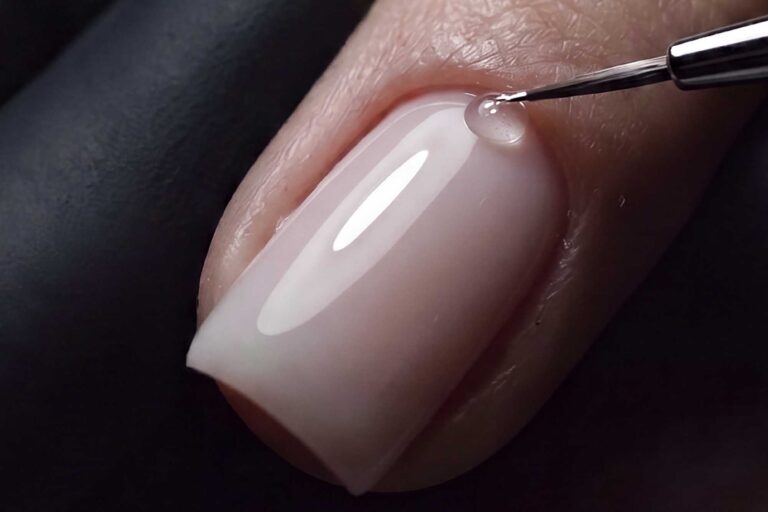
- Application: thin, even layers, cured properly between coats.
- Finish: oil, hand care, and the final check.
Time cut from preparation shows up two weeks later as lifting. Time spent there is the reason a set lasts, which we go into further in how long a gel manicure lasts.
Why a dry manicure is often the faster appointment
Every manicure at The Shade is performed fully dry. There is no bowl, no soak, no waiting for water to do something a trained hand can do better.
Soaking adds real minutes to an appointment, and it adds them at the start, before any actual work begins. It also temporarily swells the nail plate, which means shaping and polish are applied to a nail that is not in its settled state. Removing the water removes both problems at once: the appointment tightens, and the finish is applied to the nail as it will be for the next three weeks. We explain the full method in what is a dry manicure.
The second time saving is at the end. A gel finish is cured, not dried, so there is no twenty minutes of sitting still with your hands under a fan, and no ruining a nail reaching for your bag. You leave finished.
What does not get rushed
Efficiency is not the same as speed. A shorter appointment should come from removing dead time, not from skipping cuticle work or curing gel for half as long as the manufacturer specifies. Sanitation is the same principle. Tools are single-use or fully sterilized between clients, and that process is not compressed to turn a chair faster. If you want a sense of what to look for anywhere you book, our nail salon hygiene checklist is a useful reference.
Booking realistically in New York
The service length is only part of the time you should budget. A few practical notes:
- Add ten minutes on either side. Arriving slightly early means you start on time rather than negotiating your shape while the clock runs.
- Flag removal when you book. If you are arriving with an existing set, say so. It is the single most common reason appointments run over.
- Flag art when you book. A design decided in the chair turns a 60 minute appointment into a 90 minute one.
- Do not schedule a full extension set on a 45 minute lunch break. It will not fit, and rushing it produces a set you will want redone.
- Book ahead rather than walking in. An appointment-first studio can hold your time properly, because it is not absorbing unplanned arrivals into the same schedule.
How often you will be back
Appointment length matters less than cadence. Most people land on two to three weeks for gel and closer to a week for regular polish, though it varies with nail growth and how hard you are on your hands. We cover the timing in detail in how often you should get a manicure. Once you know your interval, a 60 minute appointment stops feeling like a decision and starts feeling like a standing one.
The short version
Plan on 30 to 45 minutes for a classic manicure, an hour for gel, and two hours for extensions. Add removal and art to that if either applies. And judge a studio not by how quickly it can get you out, but by whether the time it takes is going into the parts of the service that determine how the set looks in week three.
At our SoHo studio, every service is fully dry, appointment-first, and scheduled with enough time to be done properly. You will know what you are booking before you arrive, and you will leave when the booking says you will. Book your appointment at The Shade in SoHo.