Gel manicures are beloved for good reason: glossy, durable, and chip-resistant in a way traditional lacquer struggles to match. But over the past several years, more people have started talking about a less glamorous side of gel, allergic reactions. If you’ve ever noticed itching around your nails after a gel manicure, or you’ve simply heard the warnings and want to understand them, this is a calm, practical overview.
A quick note before we start: this article is informational, not medical advice. If you think you’re having a reaction, the right step is to see a professional, and we’ll talk about when that matters most.
What a gel polish allergy can look like
Gel allergies typically show up as a form of contact dermatitis, your skin reacting to something it’s been exposed to. The signs people most often describe include:
- Itching, redness, or a rash around the nails, fingertips, or where the gel touched skin.
- Dryness, flaking, or small blisters near the cuticles.
- The nail lifting from the nail bed, becoming thin, or feeling unusually sensitive.
- In some cases, reactions appearing somewhere other than the hands, since the sensitizing ingredient can transfer by touch.
One thing that surprises people: a reaction doesn’t always happen the first time. Sensitization can build gradually, so someone who had gels for years without trouble can develop a reaction later. That’s not a reason to panic, but it’s why paying attention matters.
What actually causes it
The culprit is usually not “gel” as a category, but specific ingredients in the gel, and, crucially, whether they’re cured properly.
Uncured monomers, and HEMA in particular
Gel polish hardens, or “cures,” under a UV or LED lamp. When it cures fully, the reactive ingredients bond into a stable, inert coating. The problem arises when uncured or partially cured product contacts your skin. Those uncured monomers, including a commonly discussed one called HEMA (hydroxyethyl methacrylate), are the ingredients most associated with sensitization.
HEMA isn’t inherently dangerous when it’s fully cured and kept off the skin. The risk comes from exposure to it in its uncured state, which points to the real issue.
Improper application and curing
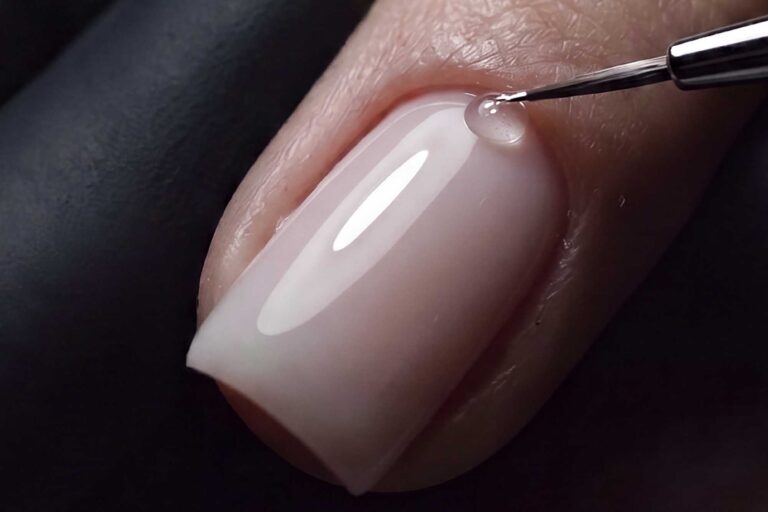
Many reactions trace back to technique rather than the product alone. Gel that touches the surrounding skin instead of staying neatly on the nail, lamps that don’t fully cure the formula they’re paired with, curing times that are cut short, or at-home kits with mismatched lamps and gels, all increase the chance that uncured product lingers against your skin. Filing into gel and creating dust can spread it too.
This is one of the clearest arguments for going to a skilled, well-equipped professional. Precise application that keeps product off the skin, and full, correct curing, dramatically reduce the risk.
How to lower your risk
You can’t eliminate every variable, but you can stack the odds in your favor.
Choose a careful, professional studio
Application precision is everything here. A technician who keeps gel off your skin, uses lamps properly matched to the product, and cures fully is your best protection. Rushed work is where problems start.
Be cautious with at-home kits
DIY gel has fueled a lot of new reactions, often because of mismatched lamps and gels or undercuring. If you do it at home, follow curing instructions exactly and keep product off your skin.
Pay attention to early signs
Mild, recurring itchiness or redness after gels is worth taking seriously rather than pushing through. Catching sensitivity early gives you the best options.
Consider how often, and what, you’re applying
Frequency and cumulative exposure play a role. Some people find that spacing out gel manicures, or alternating with other options, suits their skin better. The way a studio handles formulations and overall cleanliness matters too, which is part of the broader picture we cover in our guide to what makes a nail salon non-toxic.
Know that wear isn’t a reaction
It’s worth separating allergy from normal gel behavior. A gel that lifts at the edges after a couple of weeks is usually just ordinary wear, not necessarily a reaction, and our piece on how long a gel manicure actually lasts can help you set realistic expectations. A true reaction involves skin symptoms like itching, rash, or persistent irritation.
When to see a professional
If you’re experiencing persistent itching, a rash, blistering, nails lifting, or any reaction that doesn’t settle, stop and consult a dermatologist. They can assess what’s happening and, if needed, identify the specific ingredient through patch testing. Self-diagnosing a gel allergy is easy to get wrong, and a professional can tell you whether you can keep getting gels with adjustments or should avoid certain ingredients altogether.
The good news is that many people who develop a sensitivity can still enjoy beautiful manicures, sometimes by switching formulations, sometimes by changing how and where their gels are applied.
Our approach at The Shade
We take the quieter, less visible parts of a manicure seriously, and that includes the things that affect skin comfort. At our SoHo flagship, careful application is the standard, not the exception: we keep product where it belongs, cure properly, and pair it with cleaner formulations and rigorous hygiene throughout. The goal is a manicure that looks as good as it feels, and that respects your skin as much as your style.
Gel allergies are real, but they’re also largely about technique, curing, and care, the things a thoughtful studio is built to get right. Understanding the cause is the first step to enjoying gel without the worry.
Want gels done with precision and cleaner formulas? Book at The Shade SoHo for a manicure that’s as considerate of your skin as it is of your style.