“Non-toxic” has become one of the most-used phrases in beauty, and one of the least defined. Walk down almost any block in New York and you’ll see it in a window, on a menu, in a caption. But the term has no single regulated meaning, which makes it worth understanding what it should actually stand for when you see it on a nail salon’s door.
At its best, a non-toxic nail salon is making deliberate choices on several fronts at once: the products it puts on your nails, the air you breathe while you sit in the chair, and the way it cleans everything that touches your skin. One of those alone isn’t enough. A studio can carry a beautiful clean polish line and still cycle stale, fume-heavy air. Another can have spotless tools and a formaldehyde-based base coat on the shelf. The studios worth your time get all three right.
Here’s how to tell the difference.
It starts with the formulations
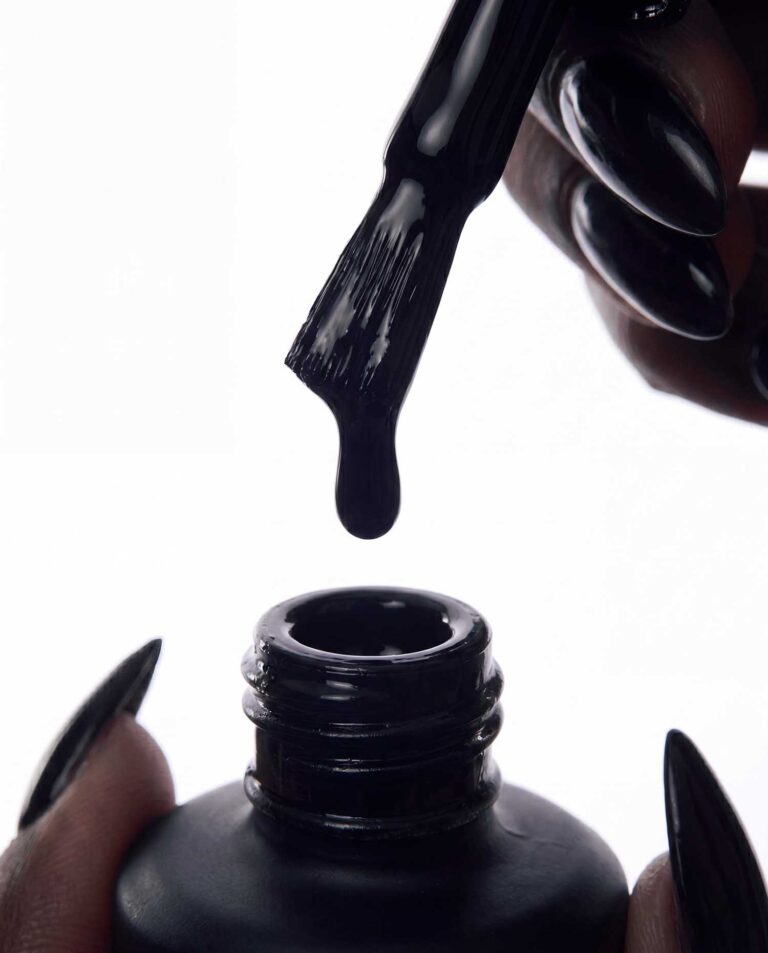
The most visible part of a non-toxic nail salon is what’s in the bottle. You’ll often see polishes described by a “free-from” number, “7-free,” “10-free,” “16-free,” and so on. Each number refers to a list of ingredients the brand has chosen to leave out. There’s no official standard governing these counts, so they’re best read as a signal of intent rather than a guarantee, but the higher, more transparent claims usually reflect a brand that has thought carefully about its chemistry. We go deeper on this in our guide to what those free-from labels actually mean.
The ingredients most often removed are the ones people ask about by name, the so-called toxic trio and the substances that tend to follow it on these lists. If you want the full picture of which ingredients these are and why they show up in conventional polish, our breakdown of the chemicals commonly found in nail polish covers it in plain language.
A genuinely non-toxic studio doesn’t just stock one clean line for marketing and reach for something harsher when a client wants longer wear. The cleaner formulations run through the whole menu, base coats, color, top coats, removers, and the team can tell you what they use and why.
The air you can’t see
Polish chemistry gets the attention, but air quality is where a lot of salons quietly fall short, and it’s one of the most important parts of the experience. Anyone who has spent twenty minutes in a poorly ventilated salon knows the feeling: the heavy, solvent-tinged air that lingers in your clothes afterward.
A thoughtful non-toxic nail salon treats ventilation as part of the design, not an afterthought. That can look like proper mechanical ventilation, source-capture systems at the stations where filing and product work happen, fresh-air exchange, and air purification running throughout the day. The cleaner the formulations, the less there is in the air to begin with, which is part of why the two go hand in hand.
The simplest test is your own senses. When you walk into a studio, does the air feel fresh, or does it announce itself? If you have respiratory sensitivities, asthma, or you’re pregnant and have concerns, this is worth paying attention to, and worth raising with a dermatologist or your physician if you’re unsure what’s right for you.
Hygiene is non-negotiable
You can’t call a salon clean in the meaningful sense if it isn’t clean in the literal one. Sanitation is the foundation, and it’s the part that protects you from the issues people most want to avoid: infections, fungal problems, and irritation.
In a well-run studio, metal tools are sterilized between every client, often in a medical-grade autoclave, and porous items like files and buffers that can’t be truly sterilized are single-use. Stations are wiped down and reset between guests. Staff wash and sanitize their hands in front of you. None of this is exotic; it’s simply done consistently, every time, whether or not anyone is watching. We’ve put together a full nail salon hygiene checklist if you want a practical list to bring with you.
This is also where the waterless approach earns its keep. Traditional pedicures rely on soaking basins, and the jetted versions in particular can be difficult to fully sanitize between clients. A dry, waterless method sidesteps that risk entirely, which is one of the reasons we built our pedicure experience around it.
The questions worth asking
You don’t need to be an expert to vet a salon. A few direct questions tell you most of what you need to know, and a confident studio will welcome them.
What’s in your polish, and what’s left out?
A clean-focused studio should be able to answer specifically, not just gesture at the word “non-toxic.” Ask which lines they carry and what their free-from standard is.
How do you sterilize your tools?
Listen for specifics: autoclave or hospital-grade sterilization for metal implements, single-use files and buffers. “We clean everything” is not the same answer.
How do you handle ventilation and air quality?
Ask whether they have dedicated ventilation or filtration. The way someone answers tells you whether it’s something they’ve actually invested in.
Are you licensed, and are your technicians licensed?
In New York, salons and technicians are required to be licensed by the state. It’s a baseline, not a luxury, and it should be easy to confirm.
How we think about it at The Shade
We built The Shade around the idea that a manicure shouldn’t ask you to trade comfort for cleanliness, or style for safety. Our SoHo flagship brings the three pillars together on purpose: cleaner, transparent formulations across the full menu, a fully dry, waterless approach to both manicures and pedicures, and sanitation standards we treat as the price of entry rather than a selling point.
The “fully dry” part matters more than it might sound. By removing water from the equation, we remove the soaking basins and the cross-contamination risks that come with them, and we keep the focus where it belongs: on careful, precise work in a space that feels as considered as the results.
“Non-toxic” should be a promise you can verify, not a word in a window. The next time you book, look past the label and check the things that actually matter, the formulas, the air, and the hygiene. If a studio gets all three right, you’ve found a good one.
Ready to feel the difference for yourself? Book your visit at The Shade SoHo and experience a manicure that’s as clean behind the scenes as it looks on your hands.