There is a version of pedicure maintenance that runs entirely on emergency. You look down in June, realize the polish from March is still clinging on in fragments, and book the first thing available. It works, in the sense that most things work eventually. But it is not a rhythm, and nails respond well to rhythm.
The more useful question is not how long you can stretch a pedicure, but how often your feet actually want attention. The answer depends on your season, your shoes, your polish, and how the service itself was performed. Here is how to think about it.
The short answer: every four to six weeks
For most people, a pedicure every four to six weeks keeps nails shaped, cuticles conditioned, and polish looking intentional rather than inherited. Toenails grow more slowly than fingernails, which is why the interval is longer than the two to three weeks most people keep for their hands.
Four weeks suits anyone in open shoes, anyone running or training regularly, or anyone who simply likes the finish crisp. Six weeks is comfortable in winter, in closed shoes, with a neutral or clear finish that grows out quietly. Beyond eight weeks, you are usually not maintaining anymore. You are restoring, and the appointment gets longer.
What actually determines your interval
The calendar is a starting point. These variables move it:
- Your polish system. Gel on toes routinely outlasts gel on hands, because feet are not doing dishes, typing, or opening things. Regular lacquer will show wear sooner.
- Your shoes. Closed, structured shoes protect polish but create pressure and friction. Sandals expose the finish to everything else.
- Your training. Running, spin, barre and long walking days all accelerate wear at the tips and the sides.
- Your nail growth rate. It varies genuinely from person to person, and it tends to speed up in warmer months.
- Your finish. A deep red or a black shows regrowth at the cuticle line within two weeks. A sheer nude can disappear into the nail for six.
New York changes the answer seasonally
This city is unusually hard on feet. Between May and September, most people are in open shoes and walking several miles a day without thinking of it as exercise. Skin builds up faster, polish takes more abuse, and the four-week interval starts to feel right rather than indulgent.
From November through March, the calculation flips. Feet spend the day in boots, in dry indoor heat, in wool. Polish holds beautifully. Skin does not. Winter pedicures are less about the finish and more about hydration and cuticle condition, which is a good argument for keeping the appointments even when no one is going to see them.
Why a dry pedicure changes the maintenance math
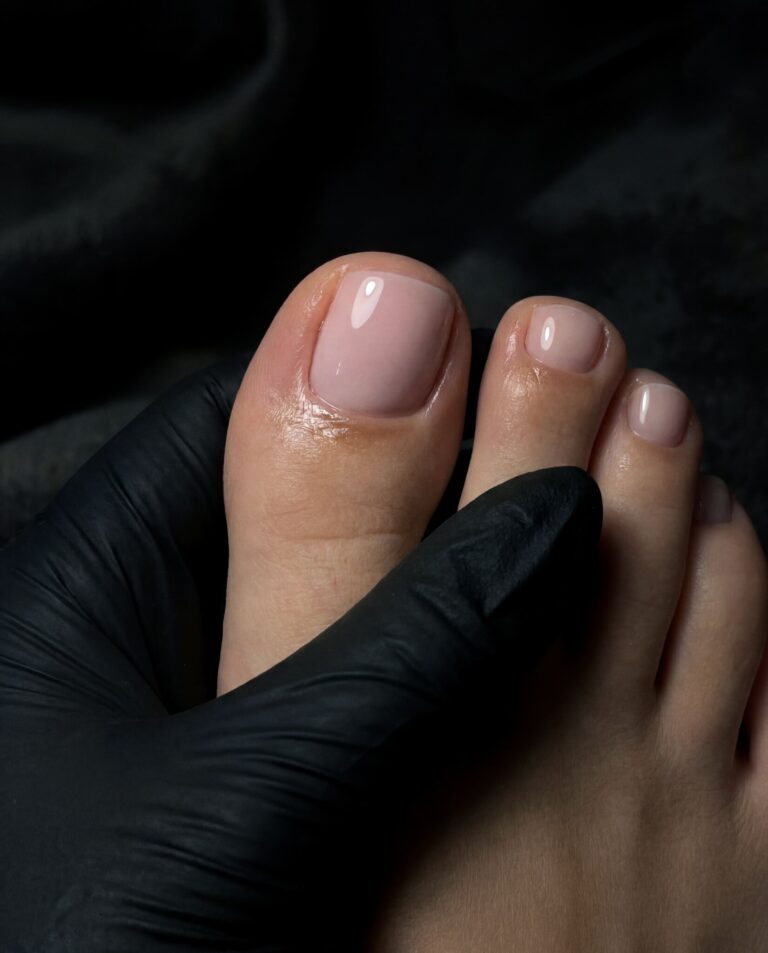
At The Shade, every pedicure is performed fully dry. No basin, no soak, no water at all. That is not a stylistic preference. It changes how long the work holds.
Soaking temporarily swells the nail plate and softens the surrounding skin. Work done on a swollen nail settles differently once it dries down, which is part of why soaked polish can lift at the edges sooner than expected. Working on a dry nail means the shaping, the cuticle work and the polish application all happen on the nail in its true state. The same logic applies to hands, which we cover in more detail in what is a dry manicure and in our comparison of a dry pedicure versus the traditional version.
There is a hygiene dimension as well. Shared foot basins are the hardest piece of equipment in any studio to sanitize properly, because of the jets and the plumbing behind them. Removing water removes that variable entirely, which we explain in why a waterless pedicure is more sanitary.
Practically, clients on a dry system often find they can hold a five or six week interval where they previously needed four.
Signs it is time to book, regardless of the calendar
- The free edge of the nail has grown past the tip of the toe and is catching on socks or sheets.
- Polish is lifting, chipping or has a visible regrowth line at the base.
- Cuticles look dry, tight or ragged.
- You have a callus that is thickening rather than softening with moisturizer.
- You have an event, a trip, or a season change coming and want the finish fresh rather than four weeks old.
When to see a professional instead
A pedicure is a grooming service, not a medical one. If you notice persistent discoloration, thickening or separation of the nail plate, an ingrown nail that is painful or inflamed, a wound that is not healing, or any change you cannot explain, see a podiatrist or dermatologist before booking. The same applies if you have diabetes, a circulatory condition, or a compromised immune system. Your physician’s guidance should come first, and a good studio will work with it rather than around it.
What to do between appointments
The interval is easier to hold when the weeks in between are not neglected.
- Apply a cream or balm to the feet at night, and cuticle oil to the nail folds several times a week.
- Dry thoroughly between the toes after showering.
- Leave the cuticle alone. Cutting it at home is the fastest route to irritation.
- Resist picking at lifting gel. It takes the top layer of the nail plate with it. Book a proper removal instead.
- Rotate your shoes so the same pressure points are not loaded every day.
Build the rhythm, not the emergency
The clients whose feet look consistently good are rarely the ones getting the most elaborate pedicures. They are the ones on a schedule. Pick an interval that matches your season and your shoes, book the next appointment before you leave, and let the maintenance become invisible.
Every pedicure at our SoHo studio is fully dry, performed with cleaner formulas and single-use or fully sterilized tools, and built to hold. Appointments open in advance, so you can set your rhythm and keep it. Book your visit to The Shade in SoHo.